Mālola Narasiṃha: Why Lakṣmī Sits Taller
Namaste!
Every family has that one story that gets told at every wedding. The in-laws, the misunderstanding, the uncle who stirred the pot, the grand reconciliation. It turns out the Lord of Ahobilam has one too, and our Chenchu guide told it with the relish of someone who has told it a thousand times and still enjoys the punchline.
In my last piece, Chenchu Chaturatha, I wrote about that guide and the nine Narasiṃhas he walked us through. This one is about the shrine where the fiercest form of the Lord turns out to be a devoted husband: Mālola Narasiṃha.
What's in a name?
Let us start with the word, because Samskṛtam always hides a little joke inside a name.
Mā is one of the names of Lakṣmī. The Amarakośa, the old Samskṛtam thesaurus, lists her as indirā lokamātā mā kṣīrodatanayā ramā: Indirā, Mother of the worlds, Mā, daughter of the Ocean of Milk, Ramā.
Lola means moving, restless, unsteady, and from there, eager and longing for something. The same word gives us lolupa, the one who craves.
So Mālola is the Lord who is restless for Mā, eager for Lakṣmī, quite simply lovesick. The usual temple translation is gentler: the one who is dear to Lakṣmī, and to whom she is dear. Both are true. But I prefer to picture it this way: the Man-Lion who tore Hiraṇyakaśipu apart with His bare claws, whom no god dared approach, is here a Lord who cannot sit still without His wife.
The story, as our guide told it
You may remember that after Hiraṇyakaśipu was slain, the Lord's fury would not settle, and Mahālakṣmī was born among the Chenchus as Chenchu Lakṣmī. Narasiṃha fell for her, married her, and became the Chenchus' son-in-law.
All well and good. But every family story needs someone to stir the pot, and in our purāṇas that job almost always goes to Nārada. Our guide's eyes twinkled as he got to this part. Nārada, he said, went straight to Mahālakṣmī with the news: "Have you heard? Your Lord has married a girl of the forest!"
Mahālakṣmī was not amused. She came down to the hills, sat in tapas, and refused to talk.
So the Lord did what every wise husband eventually learns to do. He went to her, spoke gently, pacified her, and seated her on His lap. "And that," said our guide, pointing into the sanctum, "is the Lord you see here."
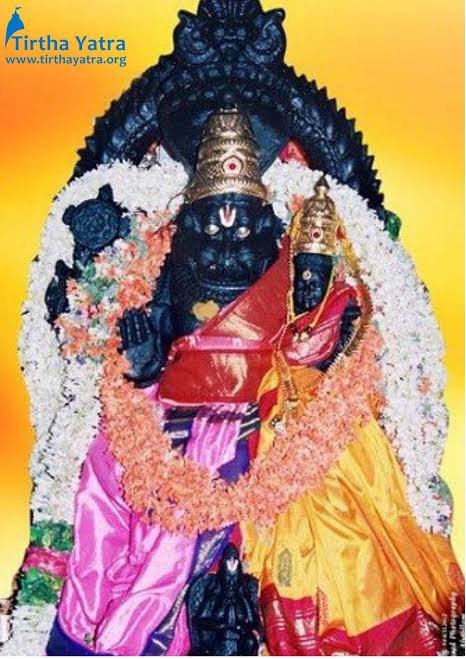
Look closely: who is taller?
In the shrine, Mālola sits with His left leg folded and His right leg resting down. Lakṣmī is seated on His folded left thigh. He has four arms; two hold the conch and the discus, and one holds her close.
Then our guide asked us to notice one detail. "See," he said, "she is taller than Him." Seated on His lap, Lakṣmī rises above the line of His shoulder.
In a tradition where every detail of a mūrti is deliberate, this is not an accident of the chisel. In the Ahobilam telling, the devas and the ṛṣis could not calm Him. Lakṣmī could. So the sculptor raised her up. In the Śrī Vaiṣṇava tradition that looks after Ahobilam, Lakṣmī is the one who intercedes for us with the Lord, His compassion in a form we can approach. The Lord who will not bend for the gods bends for her, and the sculptor quietly made sure every pilgrim would see it.
She never leaves Him anyway
If you have been to Tirumala, you already know where Lakṣmī lives: on the chest of the Lord. Śrī Venkaṭeśvara is Śrīnivāsa, literally "the dwelling place of Śrī". She resides on His heart, and the Lord is never seen without her.
And here is the fun part. Tirumala has its own "Lakṣmī was upset" story. When the sage Bhṛgu, testing the gods, kicked Viṣṇu on the chest, Lakṣmī was offended that her Lord did not object to the insult to her home, and she left Vaikuṇṭha. The Lord came down to earth looking for her, and that search is how Śrīnivāsa came to the seven hills. Two shrines, two sulks, the same ending: Lakṣmī back in her place, on His lap or on His heart.
Our tradition even builds this into how we speak. We almost never name the Lord alone. It is Lakṣmī-Nārāyaṇa, Sītā-Rāma, Rādhā-Kṛṣṇa, Umā-Maheśvara, Gaurī-Śaṅkara. Notice who comes first. When we invoke the Lord in a pūjā, the priest says Lakṣmī-sahita Śrī Mahāviṣṇu, Pārvatī-sahita Parameśvara: Viṣṇu together with Lakṣmī, Śiva together with Pārvatī. Even the honorific we place before every holy name, Śrī, is Lakṣmī herself.
Kālidāsa put it most beautifully, at the very opening of the Raghuvaṃśa:
वागर्थाविव सम्पृक्तौ वागर्थप्रतिपत्तये । जगतः पितरौ वन्दे पार्वतीपरमेश्वरौ ॥ Raghuvaṃśa 1.1 ॥
I bow to Pārvatī and Parameśvara, the parents of the world, joined like a word and its meaning, so that I may gain the right word and the right meaning.
A word and its meaning. Try separating them. You cannot have one without the other.
So who was jealous of whom?
Here is where the family drama turns into Vedānta, which is what our purāṇic stories always do when you are not looking.
Who is Chenchu Lakṣmī? She is Mahālakṣmī herself, come down to the forest as a tribal girl. She is an aṃśa, a part, a ray of Mahālakṣmī. So Mahālakṣmī was jealous of... herself.
And who is Mahālakṣmī? She is the Lord's own power, His Śrī, His glory. In Vedānta, the Lord is the māyāvī, the wielder of Māyā, and Māyā is His own power. Krishna says:
दैवी ह्येषा गुणमयी मम माया दुरत्यया । मामेव ये प्रपद्यन्ते मायामेतां तरन्ति ते ॥ 7.14 ॥
This divine Māyā of Mine, made of the three guṇas, is hard to cross. Those who take refuge in Me alone cross over it.
Notice the word mama, "Mine". Śaṅkara explains it as "of Mine, of God, of Viṣṇu", the Māyā that is His own, and he describes the Lord as the Master of that Māyā. The power is not a second person standing next to the Lord. It belongs to Him, the way heat belongs to fire. The purāṇas give that power a beautiful face and a name, Śrī, and seat her on His lap or His chest. Vedānta says the same thing without the jewellery: śakti and śaktimān, the power and the one who wields it, are not two.
So: a ray of Lakṣmī gets married, Lakṣmī gets upset, the Lord pacifies her, and all three are one. The whole drama is līlā, a play put on so that we would have a story to tell at Ahobilam and a form to fall in love with. There was never anyone to be jealous of. (Do not try this argument at home, though. "Technically, dear, you are only upset with yourself" has not worked for any husband I know.)
And now, the dinner table
Last week, at the launch of his mother's memoir, Rahul Gandhi recalled that when he was a child, "For every meal, there'd be Papa and in Papa's lap there would be mumma." When people criticised the remark, he posted pictures of temple sculptures of Pārvatī seated on Śiva's lap and of Ardhanārīśvara, and called his critics male chauvinists who do not understand India's spiritual traditions. (The Tribune, Deccan Chronicle)
Let me say clearly what I am not saying. Affection between a husband and wife is a lovely thing, and children who grow up seeing it are fortunate. How a family sits at its dinner table is that family's business. I have written before about how kāma, held within dharma, is part of a good marriage.
My objection is to the second step: holding up our temple images as if they were a family photo album. They are not, and putting the two side by side is, frankly, a little ridiculous.
- A memory is about people. A mūrti is about principles. When Lakṣmī sits on Mālola's lap, the sculptor is not recording a couple's seating arrangement at lunch. He is showing that the Lord and His power cannot be separated, like Kālidāsa's word and meaning. Ardhanārīśvara is not a picture of romance at all; it is a picture of non-duality, Śiva and Śakti in one body, because they were never two.
- The lap here is about grace, not intimacy. Lakṣmī sits on the Lord's lap in a story about fury being calmed and a sulk being soothed. The fierce becomes gentle. And she sits taller than Him. If the image is about anything, it is about honouring the Mother.
No human couple becomes Śiva and Pārvatī by sitting at a table, however sweet the memory.
To put a dinner-table anecdote next to the Mālola image cheapens the image into a debating point and turns a private memory into a political prop. Our temples deserve better than to be used in an argument, whoever is making it.
What Mālola teaches
So here is what I carried down that hill. The Lord who could not be calmed by force was calmed by love. The Goddess who seemed to be hurt was never apart from Him for a moment. The fiercest form of God is, at heart, a husband restless for His wife. And a sculptor, centuries ago, raised her a little higher, so that every pilgrim who looks up would know exactly who holds the Lord's heart.
The next time you see Lakṣmī on the lap of the Lord, do not see a couple. See the Lord and His grace, one and the same. And maybe, the next time someone at home is sulking, remember Mālola. Go gently, speak softly, and offer the higher seat.
Hari Om!
This article is researched and written by AI based on prompts and inputs given and finally approved by Rajesh Sengamedu.
Comments
No comments yet. Be the first to share your thoughts.
Add a comment
Every comment is read and approved by Rajesh before it appears here. Your email is never shown.