Chenchu Chaturatha - Wisdom of Chenchu Tribe
Namaste!
Some of the deepest lessons on a pilgrimage come not from the priest or the pamphlet, but from the person walking beside you.
A question at Ahobilam
Ahobilam sits in the Nallamala hills of Andhra Pradesh. It is the place where, tradition says, Bhagavān Narasiṃha emerged to protect the child Prahlāda, and today nine forms of the Lord are worshipped across the forested slopes. These forests are also home to the Chenchus, one of the oldest tribal communities of the region.
Our guide on the climb was a Chenchu. Somewhere between two shrines, out of curiosity, I asked him: What kind of work do the Chenchus do?
He answered without a pause. "Whatever our families have been doing for generations, we continue." Some of his people clean and look after the temples, he said. Some work as security guards for the shrines. Some guide pilgrims like me through the forest.
I had noticed the deference with which he spoke of the temple priests. So I asked him how he viewed the priest, and whether he would be able to do the priest's job himself.
He laughed at me, the way you laugh at a child who has asked something obvious. "That is not my job," he said. "That is the priest's job. I do mine as best as I can, and he does his as best as he can. We don't compete for each other's work."
A guide who was a teacher
That exchange came in the middle of a much longer conversation. All through the climb, this man taught me more about the Narasiṃha avatāra than any scholarly book I have read or any lecture I have heard.
He did not quote texts. He told the stories the way a family tells its own history. He described how, after Hiraṇyakaśipu was slain, the Lord's fury would not subside. The devas came, the ṛṣis came, one after another, each trying to pacify Him, and none could. He told me how the devas, seeing the Lord's might, are said to have cried out "Aho balam!", "What strength!", and how that cry gave this place its name. And he told me, with obvious pride, that in the end it was Lakṣmī, born among his own people, whose presence finally brought peace to the Lord.
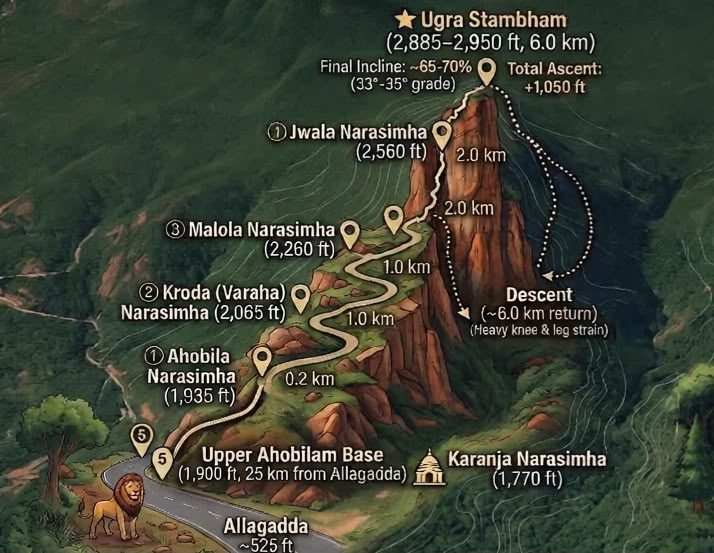
Then, shrine by shrine, he gave me the sthala-purāṇa of each of the nine Narasiṃhas:
- Ahobila Narasiṃha, the principal shrine in Upper Ahobilam, the fierce form who protected Prahlāda.
- Jvālā Narasiṃha, high on a jagged cliff, where Hiraṇyakaśipu met his end.
- Mālola Narasiṃha, the gentle form with Lakṣmī on His lap, the Lord who is dear to Mā.
- Kroḍa (Varāha) Narasiṃha, where the Man-Lion and the Boar avatāras meet.
- Kāraṅja Narasiṃha, under a karanja tree, worshipped by Hanumān.
- Bhārgava Narasiṃha, where Paraśurāma, the Bhārgava, did penance.
- Yogānanda Narasiṃha, seated in yoga, teaching Prahlāda after the storm had passed.
- Chatravaṭa Narasiṃha, under a sheltering tree, delighting in the music of the celestial gandharvas.
- Pāvana Narasiṃha, the most remote shrine, deep in the forest, the Lord who purifies.
The story he told at Kāraṅja Narasiṃha has stayed with me the most.
Hanumān, he said, came to this forest and sat under the karanja tree in deep penance, meditating on his Lord, Śrī Rāma. Pleased, Narasiṃha appeared before him. But Hanumān did not rise. He had prayed for Rāma, and the fierce Man-Lion in front of him was not the form his heart was waiting for. A devotee like Hanumān, my guide said with a smile, does not settle for any other form, not even another form of the same Lord.
So Narasiṃha did what only the Lord can do. Without giving up His own form, He appeared to Hanumān as Rāma, holding the bow and arrow. Only then did Hanumān's heart recognise his Master.
"Look," my guide said, and pointed into the sanctum. "See what He is holding." There it was: Narasiṃha, with a bow in His hand. Then he showed me what I had walked right past. As you enter the temple, before you reach the sanctum, Hanumān stands to the left, his head turned towards the sanctum in prayer, his gaze fixed on the Lord, as if he had never stopped looking since that day.
I have read about iṣṭa-devatā, the form of the Lord each devotee holds dear, in books. That morning, a Chenchu guide explained it to me with a bow, a pair of eyes, and a story.
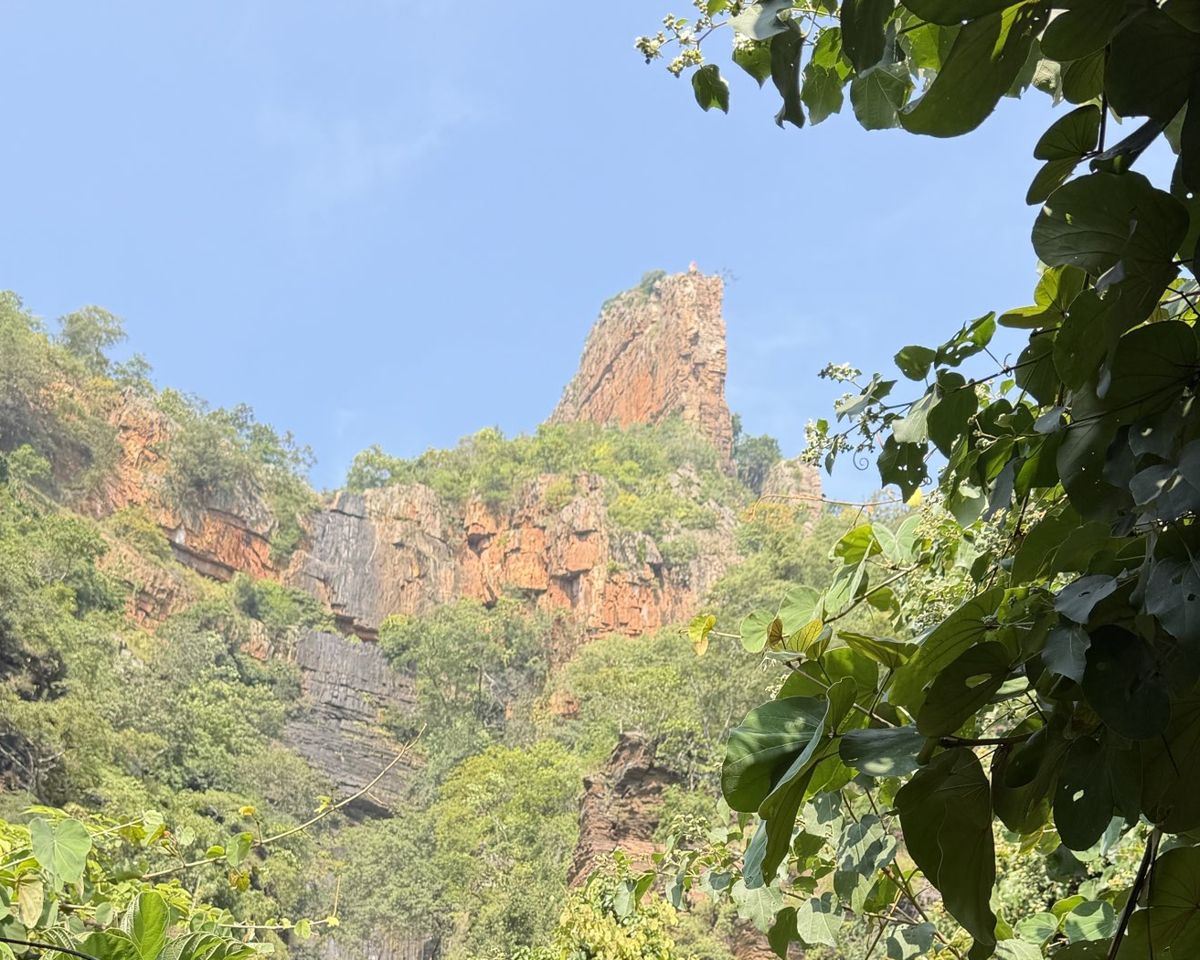
And then he pointed up at the Ugra Stambha, the great split rock that towers over Upper Ahobilam. That, he said, is the pillar from which the Lord burst forth when Hiraṇyakaśipu struck it and demanded, "Is your Hari in this pillar too?" He did not say "it is believed" or "legend has it". To him, it was simply where it happened.
I have sat through many learned discourses on this avatāra. None of them made it as alive as this man did, walking through the forest that his ancestors have shared with Narasiṃha for generations.
The chaturatha in his answer
Of everything he showed me that day, the nine shrines, the Kāraṅja Hanumān and the Ugra Stambha, it was not a sthala-purāṇa that stayed with me the longest. It was the short exchange about the priest, early in our climb, somewhere between two shrines. I kept turning his answer over on the long walk down.
Chaturatha means cleverness, a sharp practical wisdom. What struck me was how much of it was packed into that one laughing reply.
There was no envy in it, no sense of being lesser, and no wish to be someone else. There was pride in his own work and respect for the priest's. He was not measuring his life against anyone else's. He was simply doing his part, fully.
Krishna puts the same idea in two lines:
श्रेयान्स्वधर्मो विगुणः परधर्मात्स्वनुष्ठितात् । स्वधर्मे निधनं श्रेयः परधर्मो भयावहः ॥ 3.35 ॥
Better is one's own duty, even if imperfectly done, than another's duty well performed. Better to end life in one's own duty; another's duty is fraught with fear.
I explored this verse earlier in Gita Inspires 3.35: Paa, Chandramukhi and Swadharma. But here was a man in the forest living it, without ever having needed to quote it.
And in the eighteenth chapter, Krishna goes one step further:
यतः प्रवृत्तिर्भूतानां येन सर्वमिदं ततम् । स्वकर्मणा तमभ्यर्च्य सिद्धिं विन्दति मानवः ॥ 18.46 ॥
By worshipping, through one's own work, the One from whom all beings come and by whom all this is pervaded, a human being attains fulfilment.
The priest worships Narasiṃha with mantras and flowers. The Chenchu who sweeps the temple steps and keeps watch over the shrine worships the same Narasiṃha with a broom and a vigilant eye. Both are svakarmaṇā tam abhyarcya: worship through one's own work. Neither is greater.
Think how much of our modern unhappiness comes from the opposite attitude: constantly comparing our job with someone else's, feeling that the grass is greener in the next cubicle, the next company, the next career. My guide had none of that. He was at peace with his work, and therefore at peace.
Narasiṃha's family
There is a lovely twist to this story. The Chenchus do not see Narasiṃha as a distant deity who belongs to the priests. They see Him as family.
According to local tradition, Mahālakṣmī was born among the Chenchus as a tribal girl, Chenchu Lakṣmī, and Narasiṃha fell in love with her and married her. So for the Chenchus, the Lord of Ahobilam is their son-in-law. He married their daughter.
Every year, that relationship is lived out again during the Paruveta Utsavam. Beginning on Makara Saṅkrānti, the festival image of the Lord is carried for a maṇḍala, forty days, to around 32 Chenchu hamlets around Ahobilam. The Chenchus welcome Him the way any family welcomes a son-in-law of the house at Saṅkrānti: with joy, with offerings from the forest, and with the easy affection of relatives.
God did not ask about birth
This is the part of the story I keep coming back to.
When the Lord chose a bride, He did not go to a royal palace or a scholar's house. He went into the forest and married a tribal girl. When He chose His in-laws, He chose the Chenchus. In the story our tradition itself tells and celebrates every year, God did not differentiate between people on the basis of birth.
The Gītā says the same of the wise:
विद्याविनयसम्पन्ने ब्राह्मणे गवि हस्तिनि । शुनि चैव श्वपाके च पण्डिताः समदर्शिनः ॥ 5.18 ॥
The wise see with an equal eye a learned and humble brāhmaṇa, a cow, an elephant, a dog and an outcaste.
So we have two lessons from one forest. From the Chenchu guide: do your own work as worship, without envy or comparison. From the Chenchu Lakṣmī story: every work, and every person who does it, is equally dear to the Lord. The priest does his job, the guard does his, and Narasiṃha is family to both.
I have written before about how the four varṇas are by qualities and actions, not birth, in Gita Inspires 4.13. On a forest trail at Ahobilam, I met a man who seemed to have understood the spirit of it far better than many of us who read about it.
Hari Om!
This article is researched and written by AI based on prompts and inputs given and finally approved by Rajesh Sengamedu.
Comments
No comments yet. Be the first to share your thoughts.
Add a comment
Every comment is read and approved by Rajesh before it appears here. Your email is never shown.