The Monk Who Buried Himself Alive
Namaste!
On the trail at Ahobilam, between one shrine and the next, our Chenchu guide stopped, lowered his voice, and told us a story that was not about Narasiṃha at all. It was about a monk who went into a cave tunnel and never came out.
I have written about that guide twice now, in Chenchu Chaturatha and in Mālola Narasiṃha. This is the story of his that has stayed with me.
The story, as the guide told it
There was a time, he said, when the Nawabs came from Hyderabad to plunder Ahobilam. The temples here were rich: gold, jewels, ornaments offered over centuries by kings and pilgrims. The raiders wanted all of it.
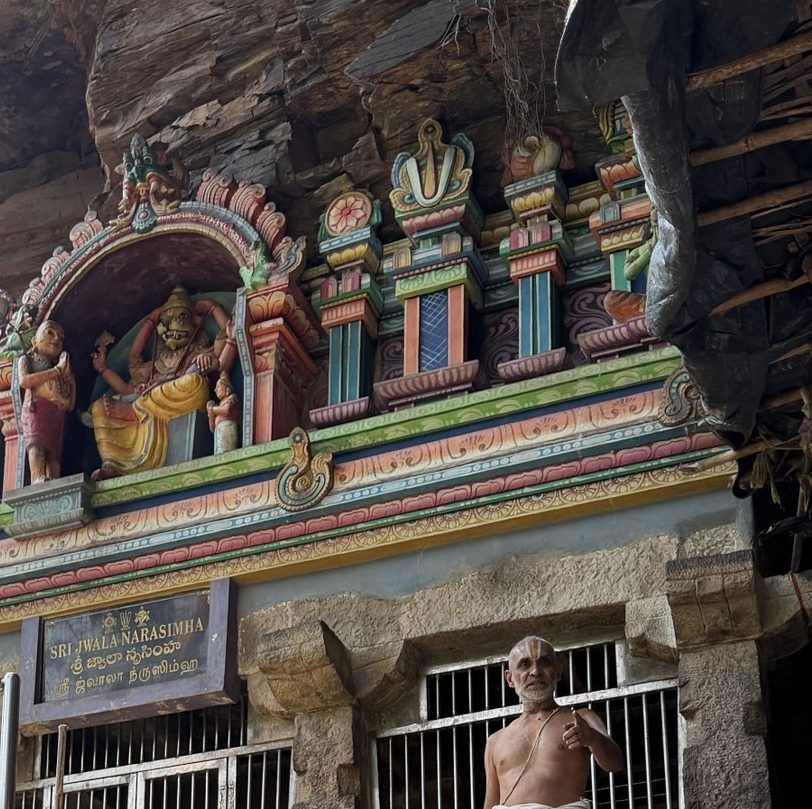
The head of the Ahobila Maṭh at the time, the Jeeyar, would not let the Lord's wealth fall into their hands. So he gathered what he could and went into a tunnel, half a kilometer deep inside the Jvālā Narasiṃha shrine, high up where the Lord is said to have torn Hiraṇyakaśipu apart. Then he had the entrance sealed behind him and entered jīva samādhi: he sat in meditation and gave up his body there, alive and of his own will, as the guardian of the treasure.
"He is still there," our guide said, and pointed up at the cliff. "Still guarding." The place itself is a ten-sided spot on the ground, about four feet across, simply cordoned off with a wire so that people do not step on it.
I will admit it gave me goosebumps.
What the records say
When I came home, I went looking for the history, because a story like this deserves to be checked as well as cherished. Here is what I found.
There really was a raid. After the Vijayanagara empire was defeated at Talikota in 1565, its hold over the region weakened, and the Deccan sultanates pushed south. Around 1578-79, the forces of the Golconda Sultanate occupied Ahobilam.
The temple was won back by a Jeeyar. An inscription of 1578-79 at Lower Ahobilam records what happened next. The seventh Jeeyar of the Ahobila Maṭh, Śrī Śaṭhakopa Yatīndra Mahādeśikan, went to the Vijayanagara king, Śrīraṅga I, and asked him to recover the temple. The king sent a chief with the Jeeyar; the occupiers were driven out, the temple was repaired, and the Jeeyar was established at Ahobilam again.
And a Jeeyar really did go into the mountain. The tradition of the Maṭh, recorded by the historian R. Vasantha, says that the sixth Jeeyar, Śrī Ṣaṣṭha Parāṅkuśa Yatīndra Mahādeśikan, was worshipping at Ahobilam when the Lord commanded him to remain there for ever. He entered a cave at Upper Ahobilam, and the cave was closed. His disciples, among them Tātācārya, waited outside for days. He never came out. The closed cave is still shown to pilgrims at Upper Ahobilam.
So the books and the guide do not tell exactly the same story. The books say the Lord asked the sixth Jeeyar to stay; the guide says he stayed to guard the Lord's treasure from raiders. The books place the raid and the rescue in the time of the seventh Jeeyar. Somewhere between the inscription and the forest trail, the two memories have braided together: a monk who never left, and a temple that was nearly lost and then won back.
I do not think we need to choose. History tells us what happened. The guide's version tells us what it meant to the people who lived around the temple: that the Lord's house had guardians who would give everything, even their bodies, to protect it.
Ahobilam was not alone
What happened at Ahobilam was one chapter in a much longer story. For centuries, the great temples of India were the richest places in the land, full of gold offered by generations of devotees, and they were raided again and again.
- Somanātha in Gujarat: plundered by Mahmud of Ghazni in 1026, rebuilt only in 1951.
- Kāśī Viśvanātha: destroyed more than once, last in 1669; today's temple was built by the Maratha queen Ahilyābāī Holkar.
- Keśavadeva at Mathurā, Kṛṣṇa's birthplace: demolished in 1670.
- Mārtaṇḍa, Kashmir's great Sun temple: a ruin since the early 1400s.
- Śrīraṅgam: raided in 1311 and again in 1323, when devotees carried the Lord, Namperumāḷ, away into the hills for nearly fifty years.
Śrīraṅgam remembers one of its guardians by name. The legend goes that as the raiders entered in 1323, a temple dancer, Veḷḷaiyammāḷ, danced before their commander to hold him back, while Piḷḷai Lokācārya slipped away with the Lord. Then she led the commander up the eastern gopuram, pushed him off, and leapt after him. That gopuram is painted white to this day, in her memory, and is still called the Veḷḷai Gopuram.
Here is the difference I notice as a pilgrim. In the Gangetic heartland, which lay under rule from Delhi for the longest time, very few of the great ancient temples survive in their original form; most of what we see in Kāśī or Mathurā today is a few centuries old. In the South, Śrīraṅgam, Madurai, Tirumala, Tañjāvūr and Ahobilam itself still stand in their full glory.
That did not happen by accident. People fought for it. The Vijayanagara empire, founded in 1336 by Harihara and Bukka with the blessings of Śrī Vidyāraṇya, stood as a wall across the South for more than two centuries. It was Kumāra Kampaṇa of Vijayanagara who defeated the Madurai Sultanate in 1371, and his general Gopaṇa who brought Namperumāḷ home to Śrīraṅgam. The Hoysaḷas and Kākatīyas before them, the Nāyakas of Madurai and Tañjāvūr after them, and later the Marathas under Śivājī and his successors, all put up a fight. In the North too, the Rajputs, the Sikhs and the Ahoms resisted, and Ahilyābāī Holkar spent her fortune rebuilding temples from Kāśī to Somanātha.
I do not tell this history to stir up anger against anyone living today. Our tradition does not ask us to carry grudges. But it does ask us to remember with gratitude. Every time we stand in front of a temple that is still standing, someone stood in front of it first: a king, a soldier, a Jeeyar, a dancer on a gopuram, a family that hid the Lord's image in the forest.
The raids have changed their clothes
Nobody sacks temples with swords today. But many of our big temples in Tamil Nadu and Andhra are now run by government departments, and that brings its own kind of raid.
Thiruparankundram. Devotees asked to light the Karthigai Deepam at an old stone lamp-pillar on Murugan's hill in Madurai, and the High Court said yes. The state government said no, citing law and order, and fought it all the way to the Supreme Court, which finally allowed a one-time lighting on Karthigai Deepam day, 24 November 2026. Governments changed; the state's stand against the devotees' lamp did not.
Tirupati. In 2024, the laddu ghee became a political storm over claims of animal fat. The investigation found no animal fat, but something just as shameful: for five years, the "ghee" sent to the Lord's kitchen was largely fake, made from palm oil and chemicals. Under a government-appointed board, the Lord's prasāda was cheated, and then it became a political football.
Ahobilam. When the Andhra government tried to put its own officer in charge here, the courts said no. The Supreme Court asked, "Why should religious places not be left to religious people?" So Ahobilam stays in the care of the Ahobila Maṭh, and its temples are being lovingly restored with the support of the TVS Group. The Lord's house, looked after by people who see it as the Lord's house.
Now it is our turn
The Jeeyars, the kings, the dancer on the gopuram: each of them did their part. The temples are still standing because of them. Whether they are standing a hundred years from now depends on us.
And the real treasure of a temple is not its gold. It is the archaka, the priest, and the lineage behind him: families who have learned the Vedas, the āgamas and the rituals by heart, from father to son, for centuries. When a temple's gold is stolen, it can be replaced. When a priest's family gives up and his son takes a job in the city, that knowledge is gone for ever. Our culture lives in those families.
So here is my request, and it is a very practical one.
- Give directly to the priest. When you do an archana or a pūjā, place your dakṣiṇā in the priest's hand, not only in the hundi. This matters most in temples run by the government, where the hundi goes to the department and the priests who keep the rituals alive are often paid very little.
- Support the next generation. Help a Veda pāṭhaśālā, or sponsor a priest's child who is learning the Vedas, so that the lineage does not end with this generation.
- Show up. Visit the old, small temples too, not just the famous ones. A temple with devotees is a temple that survives.
- Teach your children. Take them to the temple, tell them these stories, and let them grow up knowing what our ancestors protected and why.
Krishna describes the best kind of giving:
दातव्यमिति यद्दानं दीयतेऽनुपकारिणे । देशे काले च पात्रे च तद्दानं सात्त्विकं स्मृतम् ॥ 17.20 ॥
A gift given because it ought to be given, to one who can do nothing in return, at the right place, at the right time and to a worthy person: that gift is called sāttvika.
A learned priest, keeping the Lord's worship alive at the Lord's own house, is as worthy a recipient as you will ever find.
The locals say he is still there, guarding the treasure.
The next time you climb towards Jvālā Narasiṃha and pass a sealed decagon like place on the ground, pause for a moment. Someone may still be on duty in there.
Hari Om!
This article is researched and written by AI based on prompts and inputs given and finally approved by Rajesh Sengamedu.
Comments
No comments yet. Be the first to share your thoughts.
Add a comment
Every comment is read and approved by Rajesh before it appears here. Your email is never shown.